South Carolina Car Seat Laws (2026): What Parents Need to Know

South Carolina updated its child passenger safety law (S.C. Code § 56-5-6410) to align with modern best practices — and it’s one of the few states where the fine structure actually works in your favor. If you get a $150 ticket for a child restraint violation, the court is required to waive the fine if you show proof of acquiring the correct car seat before your court date. I’ve walked parents through that process more than once, and the relief on their faces when they realize they can fix it — and protect their child — instead of just paying a penalty is exactly how enforcement should work.

South Carolina recorded 1,032 traffic fatalities in 2024 — the lowest in seven years and down 18% from the 2021 peak. Preliminary 2025 data shows an even sharper drop to roughly 880 deaths, with fatal wrecks falling from 946 to 826. Despite the improvement, South Carolina’s fatality rate remains well above the national average, making proper child restraint critical on the state’s highways.

This guide breaks down every requirement in South Carolina’s current child passenger safety law, explains the fines and enforcement rules, covers special situations like taxis and rideshares, and answers the most common questions parents ask.

South Carolina car seat laws by age

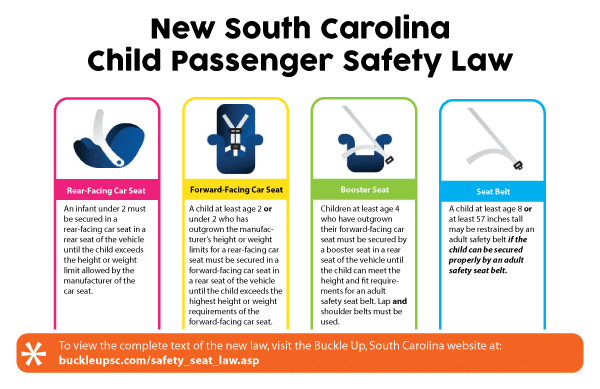
South Carolina requires every child under 8 years old to be secured in a federally approved child passenger restraint system appropriate for their age and size. Here’s exactly how the law breaks down by stage:

Rear-facing (birth to age 2): All children under 2 must ride in a rear-facing car seat secured in the rear passenger seat of the vehicle. The child stays rear-facing until they exceed the seat manufacturer’s height or weight limit — not just until they turn 2. South Carolina law specifies the rear passenger seat, meaning rear-facing seats cannot be placed in the front seat under any circumstances.

Forward-facing with harness (ages 2–4): Children ages 2 through 4 who have outgrown the rear-facing position must ride in a forward-facing car seat with a five-point harness, positioned in the rear passenger seat. The child remains in this seat until they exceed the manufacturer’s height or weight limits.

Booster seat (ages 4–8 or under 57 inches): Children ages 4 through 7 who have outgrown the forward-facing harness must use a belt-positioning booster seat with the vehicle’s lap-and-shoulder belt, in the rear passenger seat. The child stays in the booster until age 8 or until they reach 57 inches (4’9″) tall — whichever comes first.

Seat belt (age 8+ or 57 inches+): Once a child turns 8 or reaches 57 inches, they can transition to the vehicle’s adult seat belt. The belt must fit properly — the lap belt across the upper thighs (not the stomach) and the shoulder belt across the chest (not the neck). If the belt doesn’t fit correctly, the child should continue using a booster.

Back seat requirement: South Carolina law requires all children under 8 in a child restraint system to ride in the rear passenger seat. For children 8 and older, the back seat is strongly recommended until age 13 but not legally mandated.

If you’re not sure which seat fits your child’s current stage, our best-rated convertible car seats guide covers every transition from rear-facing infant through booster-ready child.

Fines and enforcement

Violating South Carolina’s child restraint law carries a $150 fine. However, the court must waive the fine if the driver provides proof of acquiring an appropriate child safety seat before the court date. This makes South Carolina one of the most parent-friendly enforcement states in the country — the law incentivizes compliance over punishment.

South Carolina’s child restraint law is a primary enforcement law, meaning an officer can pull you over solely because a child appears to be improperly restrained. You don’t need to be committing another traffic violation first.

Each improperly restrained child counts as a separate violation. If you have two children out of compliance, that’s two $150 tickets.

No points are assessed on your driver’s license for a child restraint violation in South Carolina.

Special situations

Front seat exceptions: A child under 8 may ride in the front seat only if the vehicle has no rear passenger seat, or if all rear seating positions are already occupied by children under 8 who are properly restrained. In that case, the front-seat child must still be in an appropriate child restraint system.

Taxis and rideshares: South Carolina’s child restraint law applies to all motor vehicles operated on public highways and streets — taxis and rideshare vehicles (Uber, Lyft) are not exempt. If you’re traveling with children in a taxi or rideshare, you are responsible for providing and installing an appropriate car seat.

Leaving a child unattended in a vehicle: South Carolina does not have a specific statute prohibiting leaving a child alone in a car. However, law enforcement can — and does — charge drivers with child neglect under general child endangerment statutes if the circumstances create a risk of harm (e.g., extreme heat, vehicle left running).

Smoking in a vehicle with children: South Carolina has no law prohibiting smoking in a vehicle with a child passenger.

Car seat replacement after a crash: South Carolina has no law requiring car seat replacement after an accident. However, NHTSA and all major manufacturers recommend replacing any car seat that was in a moderate-to-severe crash, as internal structural integrity may be compromised even if the seat looks undamaged.

What to do if you get a ticket

If you receive a child restraint citation in South Carolina, here’s the fastest path to resolution:

1. Buy or acquire the correct car seat immediately. The court is required to waive your $150 fine if you show proof of obtaining an appropriate car seat before your court date. Keep the receipt.

2. Get it inspected. Have a certified Child Passenger Safety Technician verify your installation. You can find one through the NHTSA technician locator or at a Safe Kids South Carolina inspection station.

3. Bring proof to court. Present your receipt and, ideally, documentation of the inspection. The judge will waive the fine.

If you need a free or low-cost car seat, check our guide to free car seats in South Carolina — Prisma Health’s Buckle Buddies program, county health departments, and local fire departments all have seats available for qualifying families.

How South Carolina compares to neighboring states

South Carolina’s law is roughly in line with its neighbors, but there are a few differences worth noting if you drive across state lines:

Georgia requires children to be in a car seat until age 8, same as South Carolina, but Georgia’s fine is only $50 (compared to SC’s $150). North Carolina requires rear-facing until age 2 and a booster through age 8 or 80 pounds — and NC does not offer a fine waiver for purchasing a seat. Tennessee requires a booster through age 8 or under 4’9″ and imposes a $50 fine plus $125 in court costs.

The takeaway: if you’re driving through multiple states, South Carolina’s requirements are a solid baseline, but always check the specific laws of any state you’re passing through.

Frequently Asked Questions

When can my child sit in the front seat in South Carolina?

There is no specific age at which a child can legally sit in the front seat in South Carolina. The law requires children under 8 to be in the rear passenger seat in a child restraint system. After age 8, children can technically sit in the front seat with a seat belt, but safety experts recommend keeping children in the back seat until age 13. The only exception for children under 8 is when the vehicle has no back seat or all rear positions are occupied by other properly restrained children.

What is the fine for a car seat violation in South Carolina?

The fine is $150 per violation, but it can be completely waived if you show proof of acquiring an appropriate car seat before your court date. No points are added to your license. Each improperly restrained child counts as a separate $150 violation.

Does South Carolina require rear-facing until age 2?

Yes. South Carolina law requires children under 2 to ride in a rear-facing car seat in the rear passenger seat. The child should stay rear-facing until they exceed the seat manufacturer’s height or weight limit, even if that’s past age 2. Our best-rated convertible car seats guide includes seats that allow rear-facing up to 40-50 pounds.

Are taxis and Uber/Lyft exempt from car seat laws in South Carolina?

No. South Carolina’s child restraint law applies to all motor vehicles on public roads, including taxis and rideshare vehicles. If you’re traveling with a child under 8, you must provide an appropriate car seat. Some parents keep a lightweight, FAA-approved travel seat for this purpose.

Can I use a secondhand car seat in South Carolina?

South Carolina doesn’t prohibit used car seats, but you should verify the seat hasn’t been in a crash, isn’t expired, isn’t recalled, and has all original parts. Check the NHTSA recall database before using any secondhand seat. Read our guide on what to do with old car seats for safe disposal options.

Where can I get my car seat inspected in South Carolina?

Safe Kids South Carolina operates inspection stations across the state. Local fire departments in Mt. Pleasant, Myrtle Beach, Summerville, North Charleston, and other cities offer free inspections. You can also find a certified CPS technician near you through NHTSA’s locator.

Sources

About Safe Parents

Safe Parents was founded by seat safety expert, Peter Z. We are dedicated to safe parenting and providing with parents resources to help protect and guide their kids.

Meet the team.

How we write

Our editorial processes adhere to our stringent editorial guidelines, ensuring articles, features, and reports are from reputable sources like the NHTSA. Our team will deliver insightful stories you can rely on. Contact us if you have any questions.

Find free car seats for your young ones.

Find communities across the internet that are helping promote car safety for kids.

More kids car safety guides