Do you need a car seat for your child but lack the funds to get one?
Unfortunately, many parents today face this issue. What some parents don't realize is that they might be eligible to get a free car seat through Medicaid. And, if you find out you can't get one through Medicaid, there are more resources.
Let's take a look.
What Is Medicaid?

First, let's discuss what Medicaid is and whom it covers.
Medicaid was signed into law with its sister program, Medicare, in 1965 under Title XIX. The federal government recognized the need for a program that would cover families who needed extra financial help.
The Center for Medicaid and CHIP Services sponsors Medicaid and CHIP. CHIP stands for Children's Health Insurance Program and is designed for families who earn too much money to be eligible for Medicaid but don't make enough money to afford private insurance.
Eligibility for Medicaid is determined on a state-by-state basis because every state has its own Medicaid division. There are set income limits, so interested families can check at a glance on their state's Medicaid website to see if they might eligible. The only way to know for certain if you are eligible for Medicaid is to apply on your state's official Medicaid website. Proof of income will be required, along with a phone interview. But, generally speaking, the family must be below their state's determined poverty level.
There is a waiting period after your interview while your eligibility is being determined. You will be required to upload documentation that proves your income, and Medicaid will take the information from these documents into account when they make their decision. This proof of income generally comes in the form of pay stubs, but other options might be available when you talk with a representative from your state's Medicaid department.
If you are accepted to Medicaid, you will receive a health insurance card, as you would for any other health care program (like SelectHealth or Molina). This card should be presented at doctors' offices, where a low co-pay will be assessed and medical services will be available if that office accepts Medicaid. Not every doctor's office accepts Medicaid, so check in advance to save time for your family.
Steps to Get a Free Car Seat Through Medicaid
If you are approved for Medicaid, getting a car seat is fairly easy:
- 1You'll first need to enroll in a course on how to properly use a car seat for your child. This is because Medicaid doesn't want to give out valuable supplies to individuals who won't properly use the provided resources.
- 2Medicaid-approved courses are available online. Talk with a Medicaid representative to see which courses will work for you.
- 3Once you've provided proof of completion, Medicaid will provide you with free car seats for your little ones.
How to Get a Free Car Seat If You Can’t Get One Through Medicaid
So, you were denied Medicaid. While this is unfortunate, all hope is not lost to keep your kids safe on the road! There are additional resources available for families in your position.
Organizations
First, there are multiple organizations providing help. Safe Kids Worldwide and Baby2Baby are two organizations that support car seats and car seat safety. Safe Kids is specifically there to make sure that your child's car seat is properly installed and to keep you updated on recalls and other relevant information. Baby2Baby is a charity that focuses on children, ages 0-12, who are living in poverty. Clothing, diapers, car seats, and more are available for young children in need. Visit their website for more information and/or to find a location near you.
Avoid Buying Car Seats at Garage Sales or Consignment Shops
When the youngest child outgrows his or her car seat, many families choose to donate or sell said car seat. Weekend garage sales and consignments shops (stores that sell used goods) have car seats.
The problem here is that not everyone is honest. A car seat could look perfectly fine, but if it's been in an accident, it's not safe to use. The owner's only concern is selling the car seat, so they aren't likely to be honest with you.
Only use a used car seat if you know the person who is donating/selling it, and they know that the car seat has not been in an accident. Also, it doesn't matter if the child was in the car seat during the accident. The force and impact of any car crash can be enough to compromise the safety of the car seat.
What to Look for When Buying a Used Car Seat
While shopping for a car seat, it's important to find one that truly keeps your little ones safe. All car seats are required to meet the same safety standards, so it comes down to finding the one that's the right fit for your child and your car. Start by measuring your car for length, width, and height, and see where the car seat buckles are located. The last thing you want is to end up with a car seat that doesn't work for your car!
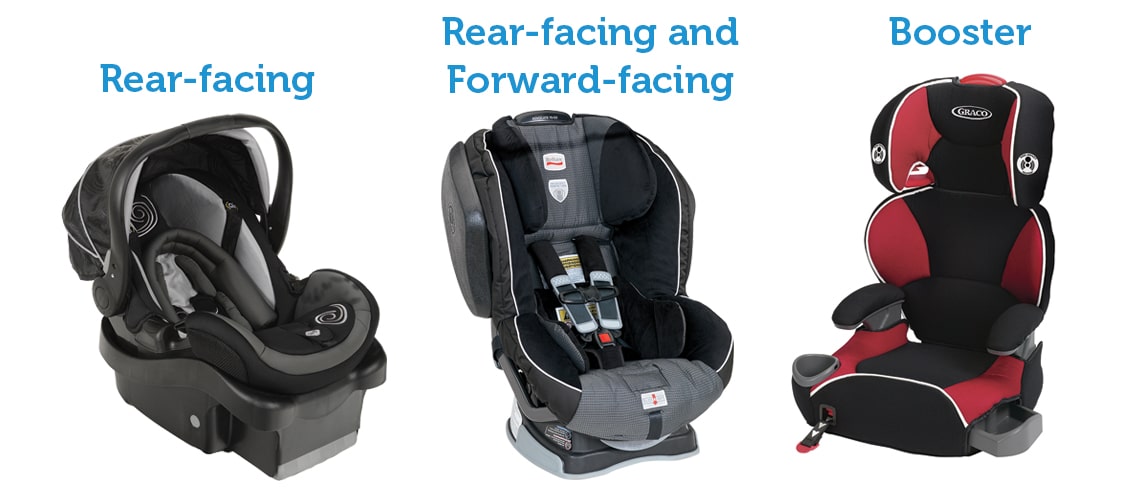
Once you've figured out what works for your car, you can choose between the different types of car seats.
1. Rear-facing car seats
Rear-facing car seats are specifically designed for newborns and babies who weigh up to 40 pounds. This type of car seat sits in the backseat in a reclining position and faces the back. This type of car seat is typically used until a child is two years old.
2. Forward-facing-only car seats
Much like the title suggests, these seats must face forward. This car seat is designed for children who have outgrown the rear-facing car seats.
3. Booster Seat or Belt-Positioning Booster Seat (BPB)
The booster seat is meant for children who have outgrown using a car seat but lack the weight or height to safely ride in the car without more than a seatbelt for support. The booster seat is designed to keep the child in a safe position. Instead of having a harness to buckle the child in, parents should position the booster seat so that the car's seatbelt sits properly on the child. Booster seats come in varying designs. Some are backless, some come with backs, and some have backs that are detachable.
What Every Car Seat Should Come With
It's important to make sure that the car seat you buy has all the proper parts. This is especially important when shopping at a garage sale or consignment shop, as the person selling it to you wants to get rid of it and might not have your child's best interest in mind. The car seat should have harness slots, harness straps, a chest clip and buckle, and a hardness adjuster button and strap on the front. On the back, there should be a tether strap and lower anchor attachments.
Don't buy a car seat that is missing any of these parts. Even if you could buy the parts separately, this could compromise your child's safety, especially in a car crash. It's very important to not do this!
Car Seat Program News By WTRF 7News
Conclusion
Not only is it important to get your child a car seat, but it's also important to make sure that the car seat is safe to use, is right for your child's weight and height, and is properly installed in your vehicle. Otherwise, the car seat could actually do more harm than good.
As frustrating as it can be to fill out applications, Medicaid is the first place you should go for a car seat because a brand new car seat is far safer and far better than a used one.
Check with the Salvation Army, Goodwill, or other local places to see if they have a new or used safe car seat. When it comes to used car seats, always read the labels.
Thoroughly inspect the car seat for signs of an accident. If there is any broken or missing part, do not use the car seat. It is not safe for your child.
Please don't transport a child without a car seat. It's far better to find someone to stay with your child if you must go to the store than to risk your child being severely injured or killed in an accident. It is very dangerous and a serious crime. The crime is severe enough that you could face jail time. Simply put, never transport a child without a car seat.
Best of luck applying for Medicaid, and congratulations if you're approved! But if not, don't give up. Bookmark this article, so you can refer back to it when you're finding the right car seat for your child. Remember that safety is most important and that it's possible to keep your child safe without breaking the bank.
Growing up I was a carefree male going about life like there was no tomorrow. Naturally, I ‘grew’ up, settled down and started a family.
Going from an independent carefree male to a family man was somewhat of a U-turn and required a lot of learning. Luckily for me, my wife works in education and has always been the shining light always ahead of me on all factors kids related.
Initially, my wife didn’t have a driving license (luckily this has now changed and it does make life easier), and all things car related were my task. Child locks were the obvious starting point which lead me down a rabbit hole.
So far we have personally tested dozens of convertible car seats and have owned five despite neither of our kids having reached the age of 5! Simply put, a car seat can be great on paper, work great on trying out but can fail on you in real life.
This is why I have put together this website – to help inform and educate you!
Of course, as I mentioned above, at the end of the day your experience will be the best test so I’d love to hear your experiences and feedback in the comments.
To contact me personally, please do so through my contact page.
I look forward to hearing from you!
Peter
P.S. If you click a link on my site and end up buying a car seat on Amazon, I’ll get paid a small commission (or as the Amazon lawyers put it: “As an Amazon Associate I earn from qualifying purchases”)
my baby is due January 6,in need of a car seat
my baby is due 2/2/2021 I need a car seat
I’m having twin boys in August my mom got me a double Graco stroller I’m in need of 2 SnugRide Click Connect seats for my stroller
My son needs a new car seat he is a year and 5 months old. The one I’ve been using is expiring in a month.
People in Hum lost County are looking for free or reduced car seats. Please help.
I am a family advocate and I have a mom who has been given a prescription for a car seat. 5 point harness type 40 – 60 lbs. Her child is severely autistic. How do I go about getting her a car seat free through medicaid using the prescription? Thank you.
I need help with a car seat and a baby stroller
Hey I’m having a hard time for my two-year-old to say in the car seat
my baby due 8/22/22 i need a car seat
My baby just turned one and has outgrown her rear facing infant car seat. I can’t Afford a new one.
I am due in November and need help affording a car seat.
I need a car seat stroller and pack n play I’m due 1/12/2023.
My baby is due February 2023 and was looking for a car seat. Where do I sign up for the program at?
Im looking for 2 booster sits for my 2 year old an 3 year old please