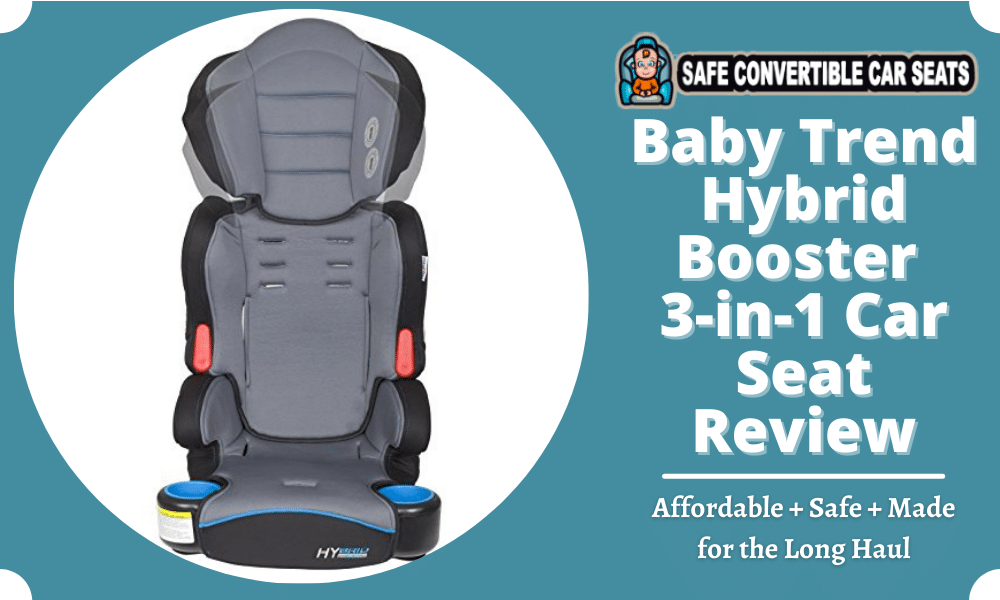
Please click image for more info
In our review of the Baby Trend Hybrid Booster 3-in-1 Car Seat, we look closely at all this model has to offer when it comes to safety, comfort, and convenience.
This money-saving, three-in-one choice is designed to be the last car seat you need to purchase for your growing child once he or she is able to ride facing forward. It’s rated for children in the weight range of 22 to 100 pounds, and between 29 and 57 inches in height.
As your little one grows, this forward-facing model can be transformed from a five-point harness seat to a high-back booster to a backless booster. It’s designed with safety in mind, with a six-position head rest for reliable side impact protection, and the included removable insert ensures a comfortable, snug fit for small children.
Overview of Baby Trend Hybrid Booster Car Seat

The first stage of the Baby Trend Hybrid incorporates a five-point safety harness that can be adjusted in the front with just one hand. As your baby grows, you can convert it to a high-back booster without the harness system. Finally, it can be used as a backless booster model.
The recommended height and weight guidelines for the Baby Trend Hybrid are as follows:
The head rest is of the Baby Trend Hybrid Booster also adjustable, with six positions that allow it to grow with your child. This adjustability makes for comfortable naps and also provides for reliable side impact protection.
The Baby Trend Hybrid is also designed with your child’s comfort in mind, as it incorporates generous padding in the arm rests, harness, and seat. The removable insert helps ensure a snug fit for small children. Unlike some other car seat models, this one features two built-in compartments for holding drinks and snacks to help keep your little one happy on car trips.
Your days of having to reach all the way back to hand over a cup are over! Parents also will surely appreciate that the fabric components like the seat pad, body insert, and harness cover can be removed easily for washing.
Safety
The Baby Trend Hybrid Booster Seat is rated by the NHTSA to meet federal safety and crash performance standards. Here’s how the NHTSA graded it for factors like usefulness of instructions and ease of use:
- Side impact protection? Yes
- Five-point harness? Yes
- Multi-position head rest: Yes
Baby Trend Hybrid Booster Video Overview
Baby Trend Hybrid Booster 3-in-1 Car Seat Specs
FEATURE | DESCRIPTION |
|---|---|
Child weight – Stage 1 | 22 - 50 pounds |
Child height – Stage 1 | 29 - 48 inches |
Child weight – Stage 2 | 40 - 100 pounds |
Child height – Stage 2 | 38 - 50 inches |
Child weight – Stage 3 | 40 - 100 pounds |
Child height – Stage 3 | 42 - 57 inches |
Car seat weight | 18.7 pounds |
Car seat dimensions | 19.6” wide x 31” high x 10.4” deep |
FAA approved | Certified for use in aircraft only in Stage 1 mode |
Baby Trend Hybrid Booster 3-in-1 Car Seat Features
FEATURE | DESCRIPTION |
|---|---|
Safety features | |
Longetivity | |
Ease of Use | |
Comfort and Convenience | |
Ease of Installation |
Who is the Baby Trend Hybrid Booster 3-in-1 Car Seat suitable for?

For parents who are looking for a single model that will see a child through the entire forward-facing car seat and booster stages, the Baby Trend Hybrid is a great option. With a comparatively affordable price, it provides a lot of bang for your buck.
The Stage 1 mode of the Baby Trend Hybrid Booster 3-in-1 car Seat is suitable for children between 22 and 50 pounds, with a height of 29 to 48 inches. The Stage 2 mode is appropriate for those between 40 and 100 pounds, with a height of 38 to 50 inches. Finally, the Stage 3 mode is designed for children between 40 and 100 pounds, with a height ranging from 42 to 57 inches.
The Baby Trend Hybrid is a convenient choice for those who travel by air, as it is certified for use on airplanes when it’s used in its Stage 1 mode. At less than 20 inches wide, it will fit easily into compact cars, and its comparatively light weight of less than 19 pounds makes it easy to travel with or transfer from vehicle to vehicle.
What is included with the Baby Trend Hybrid?
The Baby Trend Hybrid comes with a removable insert for keeping small children snug and comfortable.
Pros and Cons of the Baby Trend Hybrid
Pros
Cons
Baby Trend Hybrid Booster 3-in-1 Car Seat Installation
A tutorial installation video is available below:
Baby Trend Hybrid Booster Manual
The Baby Trend Hybrid Booster owner's manual can be found here:
Baby Trend Hybrid Booster 3-in-1 vs. Graco Tranzitions SnugLock 3 in 1:
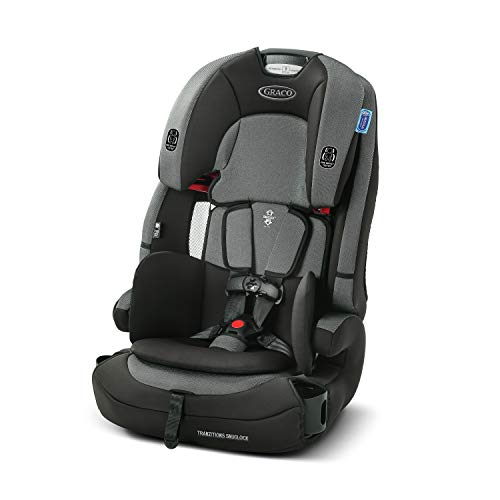
The Baby Trend Hybrid and the Graco Tranzitions SnugLock are very similar in that both can be transitioned among three modes: Harness booster, high-back booster, and backless booster. Both can be used by kids who weigh from 22 to 100 pounds. Both offer multi-position head support, are highly portable, and feature two integrated cupholders as well as fabric that can be removed for washing.
When it comes to instructions and ease of use, the Graco Tranzitions SnugLock has received slightly better reviews than the Baby Trend Hybrid from the NHTSA and parents alike. Some parents find the lack of adjustability of the Baby Trend’s bottom buckle to be a problem, whereas the Graco model offers two possible positions for that buckle.
A significant difference between the two models is the price, with the Graco being quite a bit more expensive than the Baby Trend. For its higher price tag, the Graco model provides you with a head rest that’s more adjustable and a fabric that’s more breathable.
CS Review of Baby Trend Hybrid Booster Car Seat
Conclusion
Do you worry that your toddler will grow so fast that you will have to invest in a new car seat every few months? The Baby Trend Hybrid 3-in-1 is a combination car seat -toddler booster, highback booster, and backless booster seat. It has a reasonable price tag, but it does have its flaws.
The safety rating could be better for the Hybrid 3-in-1, but overall, many booster seats score low on crash tests. It uses LATCH connectors to secure your child and lower anchors to keep the booster seal stable. However, there are issues with the instructions and labeling. For instance, the belt routing instructions do not line up with labels and manual.

Baby Trend Hybrid Booster (click image for more info)
If you like extra features, the Hybrid 3-in-1 has more extras than some other booster seat options. The headrest has six positions and adds to side impact protection. The seat pad and harnesses are machine washable for those tiny messes that will happen. It even has an extra cushion for kids on the smaller side.
The Baby Trend Hybrid 3-in-1 combination car seat weighs nearly 20 pounds. It is not super easy to move and install. But, if you only use one vehicle, it will work for you.

Growing up I was a carefree male going about life like there was no tomorrow. Naturally, I ‘grew’ up, settled down and started a family.
Going from an independent carefree male to a family man was somewhat of a U-turn and required a lot of learning. Luckily for me, my wife works in education and has always been the shining light always ahead of me on all factors kids related.
Initially, my wife didn’t have a driving license (luckily this has now changed and it does make life easier), and all things car related were my task. Child locks were the obvious starting point which lead me down a rabbit hole.
So far we have personally tested dozens of convertible car seats and have owned five despite neither of our kids having reached the age of 5! Simply put, a car seat can be great on paper, work great on trying out but can fail on you in real life.
This is why I have put together this website – to help inform and educate you!
Of course, as I mentioned above, at the end of the day your experience will be the best test so I’d love to hear your experiences and feedback in the comments.
To contact me personally, please do so through my contact page.
I look forward to hearing from you!
Peter
P.S. If you click a link on my site and end up buying a car seat on Amazon, I’ll get paid a small commission (or as the Amazon lawyers put it: “As an Amazon Associate I earn from qualifying purchases”)
But how do you get the back on? I’m been pushing down on the top for 2 days and the back still just falls backward with a slight push. This cant possibly be safe a reclining carseat? How do you get the back to attach firmy?